Under review
Medium Review (2026): Renting an Audience, and What It Costs
6.4out of 10
Medium has spent two years quietly improving how it pays writers — and none of it changes the fundamental bargain. You get readers you could not reach alone, and you do not get a home.
Filed 22 July 2026Re-read 19 September 2026
Any Medium review that begins with the editor has already missed the point. Medium’s editor is fine. Medium’s design is fine. What you are actually evaluating when you consider Medium is a trade: hand over the home, receive the readers. Everything else is detail.
The trade has got slightly better lately. Medium has spent the last two years tuning the Partner Program in ways that mostly favour writers who bring their own traffic, and the February 2026 change is a genuine improvement rather than a reshuffle. The trade has also not changed shape at all, which is the part this review keeps coming back to.
What Medium costs, in both directions
Writing on Medium is free and has no tier above it. There is no plan to upgrade to, no storage limit to manage, no domain to renew.
Reading in full costs $5 a month, or $50 a year, for a Medium membership. That membership pool is what the Partner Program pays writers out of, so the money flowing to you is the money flowing from readers who have chosen to subscribe to Medium — not to you.
That distinction is the entire review in one sentence. On a platform you own, a reader who values your work pays you and you keep the relationship. On Medium, a reader who values your work pays Medium, and Medium pays you a share determined by a formula. Both can be reasonable arrangements. Only one of them is a business you control.
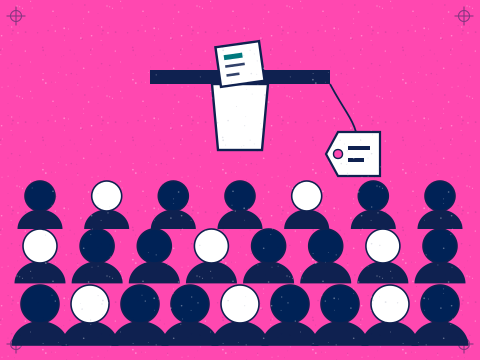
The reader pays Medium
$5 a month or $50 a year, for a membership
The membership pool
The Partner Program pays out of it, on member reads
The writer is paid a share
$10 minimum; initiated by the 10th, then five to seven business days
How the Partner Program actually pays
The mechanics, as they stand in 2026:
- Earnings accrue from member reads — time spent by paying members on your stories. Reads by non-members are worth nothing directly.
- There is a $10 minimum before a payout is issued. Below that, the balance rolls forward.
- Payouts are initiated by the 10th of each month, covering the previous month, and take a further five to seven business days to land in your account.
- Reads arriving from outside Medium — a link you shared, a social post — attract a 5% bonus over reads from inside the platform.
- Reads arriving from search engines are weighted higher still, drawing from a dedicated share of the programme budget.
- Reads arriving via email notifications to your subscribers earn more than reads from the app feed.
- Since February 2026, when a non-member hits your paywall and joins Medium to read your piece, you earn a one-time amount from that new membership.
Read that list carefully and a pattern emerges: almost every recent improvement rewards writers who bring traffic to Medium rather than writers who rely on Medium to find them. That is a rational thing for Medium to do and it is worth understanding before you plan around it. The platform is increasingly paying for distribution you supply, which raises an obvious question about why you are supplying it to someone else’s domain.
The thing you cannot get back
Medium’s export gives you an archive of your posts. It is a real export and it contains your words, and that is genuinely more than some platforms manage.
It does not contain your design, because there is not one to speak of. It does not contain your URLs — the links other people have made to your work point at Medium and will continue to. And it does not contain the readers. There is no list to download. The people who follow you on Medium are Medium accounts, and the relationship lives entirely inside the building.
This is the difference between an export and portability, and it is the single most under-discussed thing about the platform. We took every major platform apart on precisely this question in the portability audit, and Medium comes out of it worse than any other platform with a paid tier.
An export you cannot import anywhere is a souvenir, not a backup.
Custom domains are available to members and cost nothing extra, which softens the URL problem somewhat — if you point your own name at your Medium profile from the start, the links people make are at least links to an address you control. Very few writers do this, and almost nobody does it retroactively, by which point the archive of inbound links is already pointing somewhere you cannot redirect.
Where Medium genuinely wins
It would be easy to write Medium off on the basis of the above, and it would be wrong.
The distribution is real. A new independent blog gets essentially zero readers for months. A new Medium post can find an audience on the day it publishes. For a writer who needs to know whether anyone wants to read this before committing a year to it, that feedback loop has actual value.
The friction is zero. No hosting decision, no theme decision, no plan comparison, no renewal. You open a page and write. For anyone whose real obstacle is that they keep configuring instead of publishing, that is not a small thing.
Nothing is at stake. Because Medium costs nothing, an experiment that fails costs nothing either. Compare that to committing $216 a year to a platform before you know whether you will still be writing in March.
How to use Medium without being used by it
The writers who get the most out of Medium treat it as a distribution channel rather than a home. Concretely, that means:
- Publish on your own site first, then republish to Medium with the original marked as the canonical version, so search engines credit the copy you control. The mechanics of doing this without damaging yourself are in canonical tags and cross-posting.
- Point a custom domain at your Medium profile from day one if Medium is genuinely going to be your main home, so that inbound links survive a future move.
- Never let the only copy of anything live there. Keep your drafts in files you own, in a format you can read without an account.
- Do not plan around the payout formula. It has been rewritten repeatedly and will be again. Treat Partner Program income as a pleasant side effect rather than a line in a budget.
The verdict
Medium is a good place to be read and a poor place to build. Those two facts coexist and neither cancels the other.
If you are testing whether you have anything to say, or you want an audience while you work out what your actual project is, Medium is a reasonable and genuinely free answer. If you are building something — a readership, a body of work, a business with your name on it — then publishing exclusively on Medium in 2026 means constructing that thing inside a building you do not have keys to.
Our best blogging platforms guide ranks it seventh of eight for exactly that reason. It is not a bad platform. It is a platform whose interests and yours diverge the moment you start succeeding.
Queries from the postbag
Can you actually make money on Medium in 2026?
Does Medium own what I publish there?
Should I publish on Medium and my own blog at the same time?
Is the $5 Medium membership worth it as a reader?
Where this sits
Every piece on this site feeds one ranked comparison: the best blogging platforms. Start there if you want the short answer, then come back for the workings.